
Back-to-Back Test for DC Machine Efficiency
To determine the efficiency of two identical DC machines (motor and generator) using Hopkinson's test (back-to-back test or regenerative test).
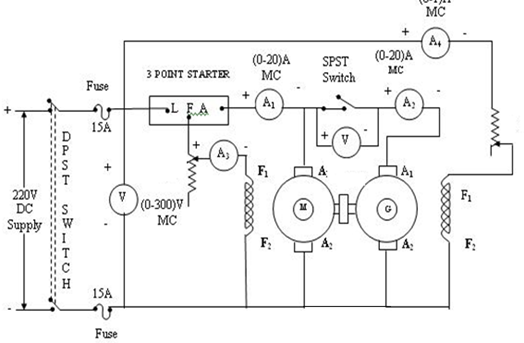
Hopkinson's test is a regenerative test method used to determine the efficiency of two identical DC machines. One machine acts as a motor driving the other machine which acts as a generator. The generator feeds back power to the motor, making this test very economical.
In this test, two identical DC machines are mechanically coupled. One machine (M) runs as a motor and drives the other machine (G) which runs as a generator. The generator supplies power back to the motor, and only the losses need to be supplied from the external source.
Power Supplied from Source:
Pinput = V × Iinput watts
This power supplies only the losses of both machines
Total Losses:
Ploss = Pinput = Losses of Motor + Losses of Generator
Motor Input Power:
PM_in = V × IM watts
Generator Output Power:
PG_out = V × IG watts
Motor Output Power:
PM_out = PG_out + Mechanical losses
Motor Efficiency:
ηM = PM_out / PM_in × 100%
Generator Efficiency:
ηG = PG_out / PG_in × 100%
Assuming Equal Losses:
Losses per machine = Pinput / 2
Motor efficiency: ηM = (PM_in - Ploss/2) / PM_in × 100%
Generator efficiency: ηG = PG_out / (PG_out + Ploss/2) × 100%
| Parameter | Value |
|---|---|
| Rated Voltage (V) | 220 V |
| Rated Current (I) | 10 A |
| Rated Power | 2 HP (1492 W) |
| Rated Speed | 1500 RPM |
| Parameter | Value |
|---|---|
| Supply Voltage (V) | 220 V |
| Input Current from Supply (Iinput) | 3.5 A |
| Motor Current (IM) | 10 A |
| Generator Current (IG) | 9.5 A |
| Motor Field Current (IfM) | 0.5 A |
| Generator Field Current (IfG) | 0.5 A |
| Speed (N) | 1500 RPM |
Step 1: Calculate Power Supplied from Source
Pinput = V × Iinput = 220 × 3.5 = 770 W
This power supplies only the losses of both machines
Step 2: Calculate Total Losses
Ploss_total = Pinput = 770 W
Assuming equal losses: Losses per machine = 770 / 2 = 385 W
Step 3: Calculate Motor Input Power
PM_in = V × IM = 220 × 10 = 2200 W
Step 4: Calculate Generator Output Power
PG_out = V × IG = 220 × 9.5 = 2090 W
Step 5: Calculate Motor Output Power
Motor output = Generator input (approximately)
PM_out ≈ PG_out + Mechanical losses
For calculation: PM_out = PM_in - LossesM
PM_out = 2200 - 385 = 1815 W
Step 6: Calculate Generator Input Power
PG_in = PG_out + LossesG
PG_in = 2090 + 385 = 2475 W
Step 7: Calculate Motor Efficiency
ηM = (PM_out / PM_in) × 100%
ηM = (1815 / 2200) × 100% = 82.5%
Step 8: Calculate Generator Efficiency
ηG = (PG_out / PG_in) × 100%
ηG = (2090 / 2475) × 100% = 84.4%
Step 9: Verification
Motor input = 2200 W
Generator output = 2090 W
Power from supply = 770 W
Check: Motor input = Generator output + Power from supply
2200 ≈ 2090 + 770 = 2860 (difference due to losses)
Actually: Motor input = Generator output + Total losses
2200 = 2090 + 110 (difference in currents × voltage)