
No-Load Test for Efficiency Predetermination
To predetermine the efficiency of a DC shunt motor at any load using Swinburne's test (no-load test method).
Swinburne's test is an indirect method of testing DC shunt motors. It requires only a no-load test to determine the efficiency at any load. This method is economical and convenient as it doesn't require actual loading of the motor.
The test is based on the assumption that for a DC shunt motor, the flux remains constant (since field current is constant), and the losses can be divided into:
No-Load Input Power:
P0 = V0 × I0 watts
Where: V0 = No-load voltage, I0 = No-load current
Constant Losses (Pc):
Pc = P0 - I0²Ra ≈ P0
Since I0 is very small, copper loss is negligible
Armature Copper Loss at Load:
Pcu = Ia²Ra watts
Where: Ia = Armature current at load, Ra = Armature resistance
Total Losses at Load:
Ploss = Pc + Ia²Ra
Efficiency at Load:
η = (Pin - Ploss) / Pin × 100%
Or: η = Pout / Pin × 100%
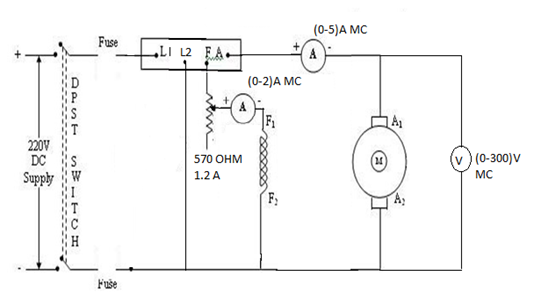
| Parameter | Value |
|---|---|
| Rated Voltage (V) | 220 V |
| Rated Current (I) | 10 A |
| Rated Power | 2 HP (1492 W) |
| Armature Resistance (Ra) | 2.5 Ω |
| Parameter | Value |
|---|---|
| No-Load Voltage (V0) | 220 V |
| No-Load Current (I0) | 2.5 A |
| Field Current (If) | 0.5 A |
| No-Load Speed (N0) | 1500 RPM |
Step 1: Calculate No-Load Input Power
P0 = V0 × I0 = 220 × 2.5 = 550 W
Step 2: Calculate Constant Losses
Armature current at no-load: Ia0 = I0 - If = 2.5 - 0.5 = 2.0 A
No-load copper loss: Ia0²Ra = (2.0)² × 2.5 = 10 W
Constant losses: Pc = P0 - Ia0²Ra = 550 - 10 = 540 W
Step 3: Calculate Input Power
Total current: I = Ia + If = 8 + 0.5 = 8.5 A
Pin = V × I = 220 × 8.5 = 1870 W
Step 4: Calculate Copper Loss
Pcu = Ia²Ra = (8)² × 2.5 = 64 × 2.5 = 160 W
Step 5: Calculate Total Losses
Ploss = Pc + Pcu = 540 + 160 = 700 W
Step 6: Calculate Output Power
Pout = Pin - Ploss = 1870 - 700 = 1170 W
Step 7: Calculate Efficiency
η = (Pout / Pin) × 100%
η = (1170 / 1870) × 100% = 62.57%